
Skip Navigation
Skip to contents

JLC : Journal of Liver Cancer

OPEN ACCESS
SEARCH
Search

Search

Page Path
HOME > Search
3 "Tumor microenvironment"
Filter
Filter
Article category
Publication year
Review Article
NRF2-Mediated immune evasion and ferroptosis resistance in hepatocellular carcinoma: implications for immune checkpoint inhibitor response
Setya Jenio Malangi, Dian Siswanto, Mansur Ibrahim, Noviana Dwi Lestari, Muhaimin Rifa'i
Received May 27, 2026  Accepted June 28, 2026  Published online June 30, 2026  
DOI: https://doi.org/10.17998/jlc.2026.06.28    [Accepted]
  • 528 Views
  • 60 Downloads
AbstractAbstract PDF
Hepatocellular carcinoma (HCC) remains a major cause of cancer-related mortality, and immune checkpoint inhibitors have become central to systemic treatment for advanced disease. However, durable responses are limited to a subset of patients, indicating the need to clarify tumor-intrinsic mechanisms that shape immune resistance. Nuclear factor erythroid 2–related factor 2 (NRF2), encoded by Nuclear Factor Erythroid 2-Related Factor 2 Like 2 (NFE2L2), is a stress-responsive transcription factor that regulates antioxidant defense, detoxification, metabolism, and redox adaptation. Although transient NRF2 activation protects hepatocytes from oxidative injury, persistent activation in HCC may promote tumor survival, immune escape, and resistance to therapy. Emerging evidence links NRF2 activity to two biologically connected processes: suppression of ferroptosis and remodeling of the tumor immune microenvironment. Through downstream targets involved in glutathione synthesis, cystine transport, iron handling, and lipid peroxide detoxification, NRF2 can reduce ferroptotic vulnerability. In parallel, NRF2-associated inflammatory and immune-regulatory pathways, including the Cyclooxygenase-2 - Prostaglandin E2 (COX2–PGE2) axis, may contribute to immune-cold phenotypes and impaired response to immune checkpoint blockade. This review summarizes current evidence on NRF2/KEAP1 signaling in HCC, with emphasis on its role in immune escape, ferroptosis suppression, and its potential implications as a biomarker and therapeutic target for understanding and potentially improving immune checkpoint inhibitor responsiveness. We also discuss the potential of NRF2-related biomarkers and therapeutic strategies, while emphasizing the challenges of selectively targeting NRF2 in patients with underlying liver dysfunction.
Close layer
Original Article
Isolation and characterization of cancer-associated fibroblasts in the tumor microenvironment of hepatocellular carcinoma
Kyoungdo Mun, Jiwon Han, Pureun Roh, Jonggeun Park, Gahee Kim, Wonhee Hur, Jeongwon Jang, Jongyoung Choi, Seungkew Yoon, Youngkyoung You, Hojoong Choi, Pilsoo Sung
J Liver Cancer. 2023;23(2):341-349.   Published online June 12, 2023
DOI: https://doi.org/10.17998/jlc.2023.04.30
  • 11,699 Views
  • 351 Downloads
  • 12 Citations
AbstractAbstract PDF
Background/Aim
Cancer-associated fibroblasts (CAFs) play an immunosuppressive role in the tumor microenvironment (TME) of human cancers; however, their characteristics and role in hepatocellular carcinoma (HCC) remain to be elucidated.
Methods
Nine tumor and surrounding liver tissue samples from patients with HCC who underwent surgery were used to isolate patient-derived CAFs. Cell morphology was observed using an optical microscope after culture, and cell phenotypes were evaluated using flow cytometry and immunoblotting. Cytokines secreted by CAFs into culture medium were quantified using a multiplex cytokine assay.
Results
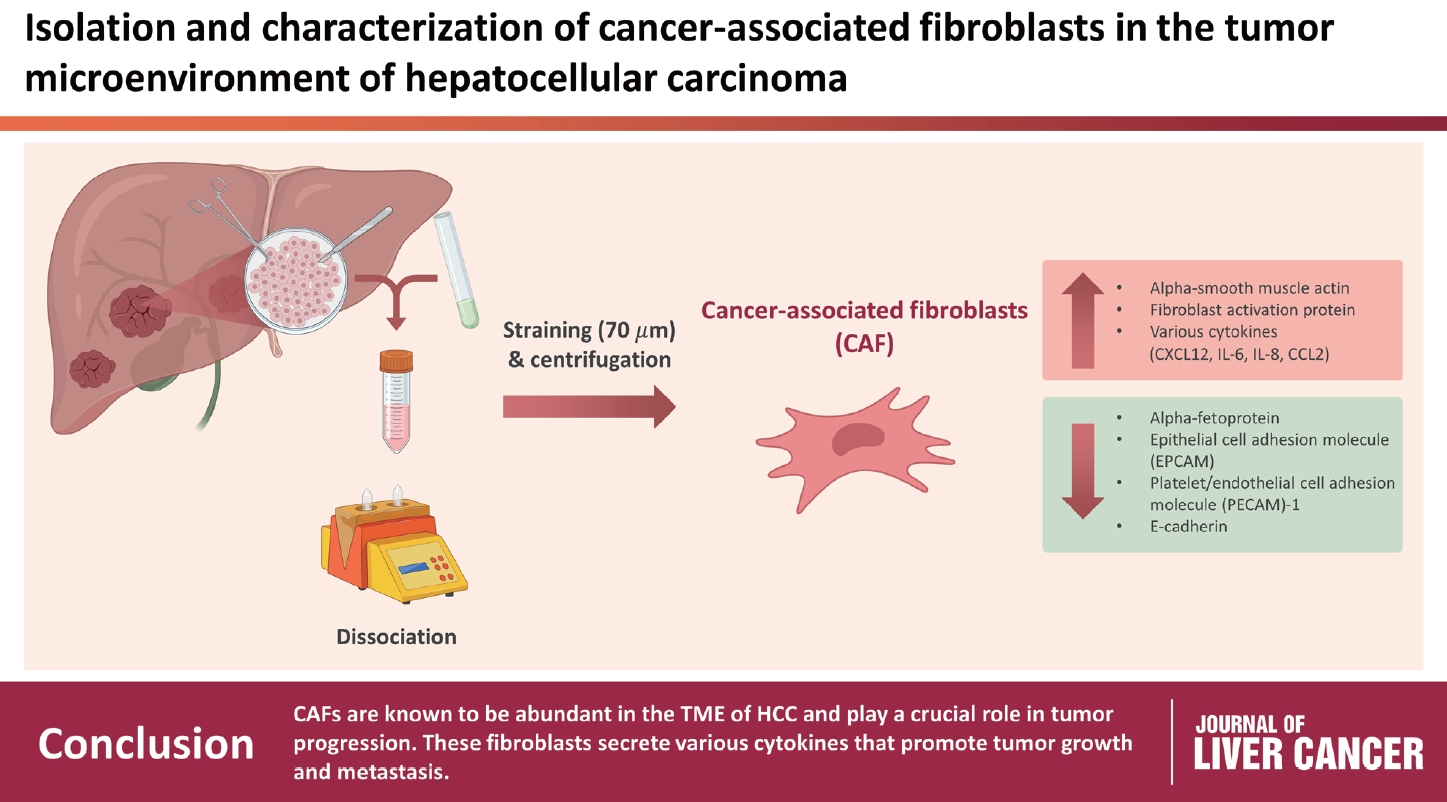
CAFs were abundant in the TME of HCC and were adjacent to immune cells. After culture, the CAFs and non-tumor fibroblasts exhibited spindle shapes. We observed a robust expression of alpha-smooth muscle actin and fibroblast activation protein in CAFs, whereas alpha-fetoprotein, epithelial cell adhesion molecule, platelet/endothelial cell adhesion molecule-1, and E-cadherin were not expressed in CAFs. Furthermore, CAFs showed high secretion of various cytokines, namely C-X-C motif chemokine ligand 12, interleukin (IL)-6, IL-8, and C-C motif chemokine ligand 2.
Conclusions
CAFs are abundant in the TME of HCC and play a crucial role in tumor progression. These fibroblasts secrete cytokines that promote tumor growth and metastasis.

Citations

Citations to this article as recorded by  
  • Modeling CAF-tumor interactions to overcome therapy resistance
    Jakub Gubala, Daniel Benamran, Petros Tsantoulis, Valentin Mieville, Massimo Valerio, Patrycja Nowak-Sliwinska
    Journal of Experimental & Clinical Cancer Research.2026;[Epub]     CrossRef
  • HERC1 oncogene enhances stemness and tumorigenic potential in CD44+-derived organoids of head and neck squamous cell carcinoma through IL-6/STAT3 signaling
    Eunjin Jeong, Hye Lin Kim, Seohee Park, Seojin Jang, Jamin Ku, Hajeong Kim, Haeun Kim, Seo Lyn Choi, Kang Pa Lee, Suji Baek, Jeong-Yoon Yang, Jung Ho Park, Jangok Yeo, Jae Jun Lee, Sei Young Lee, Seok-Hyung Kim, Hong Sook Kim, Chang-Whan Yoon, Sang-Hyuk L
    Oncogene.2026; 45(19): 1840.     CrossRef
  • Cancer-associated fibroblasts in hepatocellular carcinoma: heterogeneity, mechanisms and therapeutic targets
    Yutong Li, Mawieh Hamad, Eyad Elkord
    Hepatology International.2025; 19(2): 325.     CrossRef
  • Cancer-associated fibroblasts in hepatocellular carcinoma: origins, heterogeneity, and therapeutic implications
    Xin Shi, Weixiong Zhu, Jianpeng Zhang, Chuanlei Fan, Jing Zhang
    Frontiers in Immunology.2025;[Epub]     CrossRef
  • The Immunomechanical Checkpoint PYK2 Governs Monocyte-to-Macrophage Differentiation in Pancreatic Cancer
    Wenyan Xie, Xin Yu, Qingxin Yang, Nengwen Ke, Ping Wang, Hao Kong, Xiangji Wu, Panpan Ma, Lang Chen, Jie Yang, Xiuqin Feng, Yuan Wang, Hubing Shi, Lu Chen, Yun-Hua Liu, Bi-Sen Ding, Qiang Wei, Hong Jiang
    Cancer Discovery.2025; 15(8): 1740.     CrossRef
  • Hotspots and frontiers of the relationship between hepatocellular carcinoma and cancer-associated fibroblasts: a bibliometric analysis and review
    Huixia Zheng, Lingling Ren, Guanglan Chen, Xiangcheng Hu
    Discover Oncology.2025;[Epub]     CrossRef
  • Rebuilding the microenvironment of primary tumors in humans: a focus on stroma
    Siwon Mun, Hyun Jin Lee, Pilnam Kim
    Experimental & Molecular Medicine.2024; 56(3): 527.     CrossRef
  • Intrahepatic IgA complex induces polarization of cancer-associated fibroblasts to matrix phenotypes in the tumor microenvironment of HCC
    Jong Geun Park, Pu Reun Roh, Min Woo Kang, Sung Woo Cho, Suhyun Hwangbo, Hae Deok Jung, Hyun Uk Kim, Ji Hoon Kim, Jae-Sung Yoo, Ji Won Han, Jeong Won Jang, Jong Young Choi, Seung Kew Yoon, Young Kyoung You, Ho Joong Choi, Jae Yong Ryu, Pil Soo Sung
    Hepatology.2024; 80(5): 1074.     CrossRef
  • Machine learning model reveals roles of interferon‑stimulated genes in sorafenib‑resistant liver cancer
    Deok Seo, Ji Park, Hee Jung, Min Kang, Byung Kang, Dong Lee, Jae Lee, Seung Yoon, Jeong Jang, Jae Ahn, Pil Sung
    Oncology Letters.2024;[Epub]     CrossRef
  • Recent Advances in Immune-based Therapy for Hepatocellular Carcinoma
    Kyung Won Park, Tae Hoon Park, Eun Ji Jang, Pil Soo Sung
    Journal of Digestive Cancer Research.2024; 12(2): 115.     CrossRef
  • Wound healing: insights into autoimmunity, ageing, and cancer ecosystems through inflammation and IL-6 modulation
    Lukáš Lacina, Michal Kolář, Lucie Pfeiferová, Peter Gál, Karel Smetana
    Frontiers in Immunology.2024;[Epub]     CrossRef
  • Prognostic significance of combined PD-L1 expression in malignant and infiltrating cells in hepatocellular carcinoma treated with atezolizumab and bevacizumab
    Jaejun Lee, Jae-Sung Yoo, Ji Hoon Kim, Dong Yeup Lee, Keungmo Yang, Bohyun Kim, Joon-Il Choi, Jeong Won Jang, Jong Young Choi, Seung Kew Yoon, Ji Won Han, Pil Soo Sung
    Frontiers in Immunology.2024;[Epub]     CrossRef
Close layer
Review Article
A clinical and pathological update on hepatocellular carcinoma
Salvatore Lorenzo Renne, Luca Di Tommaso
J Liver Cancer. 2022;22(1):14-22.   Published online March 31, 2022
DOI: https://doi.org/10.17998/jlc.2022.03.18
  • 23,238 Views
  • 790 Downloads
  • 24 Citations
AbstractAbstract PDF
It is estimated that more than 1 million individuals will be affected annually by hepatocellular carcinoma (HCC) by 2025. HCC can be broadly grouped into two major molecular subgroups, each of which is characterized by specific morphological and phenotypic features that mirror the genetic background. The use of these tissue biomarkers in the daily practice of pathologists promises to better allocate patients with HCC with adequate treatments. In turn, this will likely boost the attitude of clinicians toward obtaining a pre-treatment biopsy.

Citations

Citations to this article as recorded by  
  • Nuclear miR-3920 expression in hepatocellular carcinoma is associated with stemness marker expression and poorer prognosis
    Hyunjin Park, Seunghye Kim, Hyejung Lee, Hee Young Na, Jeong Eun Yoo, Haeryoung Kim
    Digestive and Liver Disease.2026; 58(3): 390.     CrossRef
  • Label-free multiphoton microscopy and machine learning for recognition of hepatocellular carcinoma
    Roberta Galli, Sandra Korn, Daniela Aust, Gustavo B. Baretton, Jürgen Weitz, Edmund Koch, Carina Riediger
    Scientific Reports.2026;[Epub]     CrossRef
  • Functional Interpretation of Recurrent Genetic Variants in Hepatocellular Carcinoma: Molecular Consequences and Clinical Relevance
    Yuntao Ye, Zhulin Xu, Jiang Wang, Chunyu Chen, Yuan Peng, Bo Li, Shaoqiu Chen
    Human Mutation.2026;[Epub]     CrossRef
  • Prognostic factors in first-line atezolizumab-bevacizumab treatment of intermediate or advanced hepatocellular carcinoma
    Kyowon Gu, Tae Wook Kang, Jaeseung Shin, Dong Hyun Sinn, Myung Ji Goh, Jung Yong Hong, Sangah Chi, Po-Yao Hsu
    PLOS One.2026; 21(7): e0354176.     CrossRef
  • Identifying Subgroup at High Risk of Transarterial Chemoembolization Failure Among Patients with Hepatocellular Carcinoma Awaiting Liver Transplantation
    Edoardo Poli, Marc-Antoine Allard, Astrid Laurent-Bellue, Maïté Lewin, Catherine Guettier, Daniel Azoulay, Audrey Coilly, Alexandre Dos Santos, Jamila Faivre, Eric Vibert, Alina Pascale, Clara Prud’homme, Antonio Sa Cunha, Faouzi Saliba, Jean Charles Ducl
    Livers.2025; 5(1): 9.     CrossRef
  • Biosocial Determinants of Health Among Patients with Chronic Liver Disease and Liver Cancer
    Tagari Samanta, Jun Hyoung Park, Benny Abraham Kaipparettu
    Cancers.2025; 17(5): 844.     CrossRef
  • Protein profiling uncovers IGF-1R inhibition potential of 3-(2-furoyl)-indole scaffolds in hepatocellular carcinoma
    Efficiency Myrsing, H. M. Chandra Mouli, Pallaprolu Nikhil, Deepali, Abhishek Sahu, Anupam Jana, P. Ramalingam
    Future Medicinal Chemistry.2025; 17(5): 513.     CrossRef
  • Membranous Overexpression of Fibronectin Predicts Microvascular Invasion and Poor Survival Outcomes in Patients with Hepatocellular Carcinoma
    Yoon Jung Hwang, Hyejung Lee, Suk Kyun Hong, Su Jong Yu, Haeryoung Kim
    Gut and Liver.2025; 19(2): 275.     CrossRef
  • Lymph node metastasis in patients with hepatocellular carcinoma using machine learning: a population-based study
    Li Yuqin, Li Hongyan, Li Hongyuan, Li Tingting, He Kun, Fang Jie, Han Yunhui
    Frontiers in Oncology.2025;[Epub]     CrossRef
  • An Uncommon Case of Severe Gastric Ulceration Following Radioembolization for Hepatocellular Carcinoma: Clinical Insights and Management Challenges
    Saad Aldosari, Ahmad A Alsolmi, Abdullah Alsulami, Nawaf Halabi, Fatimah Alturkistani
    Cureus.2025;[Epub]     CrossRef
  • Radiofrequency Ablation versus Surgical Resection in Elderly Hepatocellular Carcinoma: A Systematic Review and Meta-Analysis
    Jeong-Ju Yoo, Sujin Koo, Gi Hong Choi, Min Woo Lee, Seungeun Ryoo, Jungeun Park, Dong Ah Park
    Current Oncology.2024; 31(1): 324.     CrossRef
  • Comparison of Surgical Resection and Radiofrequency Ablation in Elderly Patients with Hepatocellular Carcinoma
    Jun Il Kim, Jayoun Lee, Gi Hong Choi, Min Woo Lee, Dong Ah Park, Jeong-Ju Yoo
    Digestive Diseases and Sciences.2024; 69(3): 1055.     CrossRef
  • Enhancing liver cirrhosis varices and CSPH risk prediction with spleen stiffness measurement using 100-Hz probe
    Jeong-Ju Yoo, Sun Ah Maeng, Young Chang, Sae Hwan Lee, Soung Won Jeong, Jae Young Jang, Gab Jin Cheon, Young Seok Kim, Hong Soo Kim, Sang Gyune Kim
    Scientific Reports.2024;[Epub]     CrossRef
  • A Nomogram Based on Features of Ultrasonography and Contrast-Enhanced CT to Predict Vessels Encapsulating Tumor Clusters Pattern of Hepatocellular Carcinoma
    Litao Ruan, Jingtong Yu, Xingqi Lu, Kazushi Numata, Dong Zhang, Xi Liu, Xiaojing Li, Mingwei Zhang, Feiqian Wang
    Ultrasound in Medicine & Biology.2024; 50(12): 1919.     CrossRef
  • NADPH oxidase 4 deficiency promotes hepatocellular carcinoma arising from hepatic fibrosis by inducing M2-macrophages in the tumor microenvironment
    Ji Young Kim, Wonseok Kang, Sera Yang, Su Hyun Park, Sang Yun Ha, Yong-Han Paik
    Scientific Reports.2024;[Epub]     CrossRef
  • Identification of gallbladder cancer by direct near-infrared measurement of raw bile combined with two-trace two-dimensional correlation analysis
    Eunjin Jang, Woosuk Sohng, Dongho Choi, Hoeil Chung
    The Analyst.2023; 148(2): 374.     CrossRef
  • Measurement of Heavy Metal and Antioxidant-Oxidant Levels in Tissues Obtained From Three Different Localizations of Explant Hepatectomy of Patients With Hepatocellular Carcinoma
    Cemalettin Koc, Sami Akbulut, Kemal Baris Sarici, Muhammed Mehdi Uremis, Ufuk Gunay Dogan, Zeynep Kucukakcali, Ibrahim Umar Garzali, Ertugrul Karabulut, Yusuf Turkoz, Sezai Yilmaz
    Transplantation Proceedings.2023; 55(5): 1262.     CrossRef
  • Adding MRI as a Surveillance Test for Hepatocellular Carcinoma in Patients with Liver Cirrhosis Can Improve Prognosis
    Su Jong Yu, Jeong-Ju Yoo, Dong Ho Lee, Su Jin Kim, Eun Ju Cho, Se Hyung Kim, Jeong-Hoon Lee, Yoon Jun Kim, Jeong Min Lee, Jae Young Lee, Jung-Hwan Yoon
    Biomedicines.2023; 11(2): 382.     CrossRef
  • Development of a sorafenib-loaded solid self-nanoemulsifying drug delivery system: Formulation optimization and characterization of enhanced properties
    Chaemin Lim, Dayoon Lee, Mikyung Kim, Subin Lee, Yuseon Shin, Jacob D. Ramsey, Han-Gon Choi, Eun Seong Lee, Yu Seok Youn, Kyung Taek Oh
    Journal of Drug Delivery Science and Technology.2023; 82: 104374.     CrossRef
  • Validation of MELD 3.0 scoring system in East Asian patients with cirrhosis awaiting liver transplantation
    Jeong-Ju Yoo, Jong-In Chang, Ji Eun Moon, Dong Hyun Sinn, Sang Gyune Kim, Young Seok Kim
    Liver Transplantation.2023; 29(10): 1029.     CrossRef
  • Higher Number of Tumor-Infiltrating PD-L1+ Cells Is Related to Better Response to Multikinase Inhibitors in Hepatocellular Carcinoma
    Ji Won Han, Ji Hoon Kim, Dong Hyun Kim, Jeong Won Jang, Si Hyun Bae, Jong Young Choi, Seung Kew Yoon, Jaegyoon Ahn, Hyun Yang, Pil Soo Sung
    Diagnostics.2023; 13(8): 1453.     CrossRef
  • Risk of dyslipidemia in chronic hepatitis B patients taking tenofovir alafenamide: a systematic review and meta-analysis
    Eui Gwon Hwang, Eun-Ae Jung, Jeong-Ju Yoo, Sang Gyune Kim, Young Seok Kim
    Hepatology International.2023; 17(4): 860.     CrossRef
  • Recent application of artificial intelligence on histopathologic image-based prediction of gene mutation in solid cancers
    Mohammad Rizwan Alam, Kyung Jin Seo, Jamshid Abdul-Ghafar, Kwangil Yim, Sung Hak Lee, Hyun-Jong Jang, Chan Kwon Jung, Yosep Chong
    Briefings in Bioinformatics.2023;[Epub]     CrossRef
  • Role of pelitinib in the regulation of migration and invasion of hepatocellular carcinoma cells via inhibition of Twist1
    Sewoong Lee, Eunjeong Kang, Unju Lee, Sayeon Cho
    BMC Cancer.2023;[Epub]     CrossRef
Close layer

JLC : Journal of Liver Cancer
TOP
