
 E-submission
 Get new issue alerts
 THE KOREAN LIVER CANCER ASSOCIATION

Search
- Page Path
- HOME > Search
Case Reports
- Multidisciplinary approach for hepatocellular carcinoma arising from cirrhotic liver with Budd-Chiari syndrome: a case report
- Sangmi Kim, Ji Hoon Kim, Ji Won Han, Jeong Won Jang, Jong Young Choi, Seung Kew Yoon, Pil Soo Sung
- J Liver Cancer. 2022;22(2):202-206. Published online September 20, 2022
- DOI: https://doi.org/10.17998/jlc.2022.09.17
- 5,971 Views
- 76 Downloads
- 1 Citation
-
 Abstract
 PDF
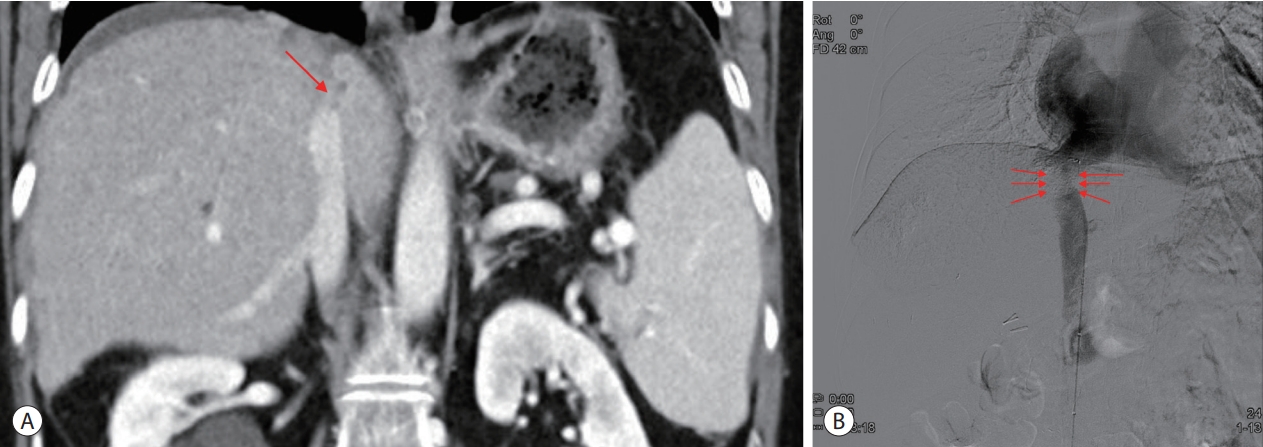
- Budd-Chiari syndrome (BCS) is defined by the obstruction of the hepatic venous outflow between the small hepatic veins and the junction of the inferior vena cava (IVC) with the right atrium. BCS with IVC obstruction occasionally progresses to hepatocellular carcinoma (HCC). Here, we report the case of a patient with HCC arising from a cirrhotic liver with BCS, in whom the hepatic portion of the IVC was obstructed, and who had a favorable outcome with a multidisciplinary approach and IVC balloon angioplasty.
-
Citations
Citations to this article as recorded by
- Multidisciplinary collaboration successfully treated Budd Chiari syndrome complicated with hepatocellular carcinoma rupture and bleeding: A case report
Lian Liao, Yuyang Qiu, Xiaobo Gong
Medicine.2025; 104(51): e46748. CrossRef
- Multidisciplinary collaboration successfully treated Budd Chiari syndrome complicated with hepatocellular carcinoma rupture and bleeding: A case report

- Hepatocellular carcinoma with Budd-Chiari syndrome due to membranous obstruction of the inferior vena cava with long-term follow-up: a case report
- Choong Hee Kim, Gwang Hyeon Choi, Hee Young Na, Chang Jin Yoon, Jai Young Cho, Sangmi Jang, Ji Hye Kim, Eun Sun Jang, Jin-Wook Kim, Sook-Hyang Jeong
- J Liver Cancer. 2022;22(2):194-201. Published online September 15, 2022
- DOI: https://doi.org/10.17998/jlc.2022.08.24
- 8,204 Views
- 95 Downloads
- 1 Citation
-
Abstract
PDF
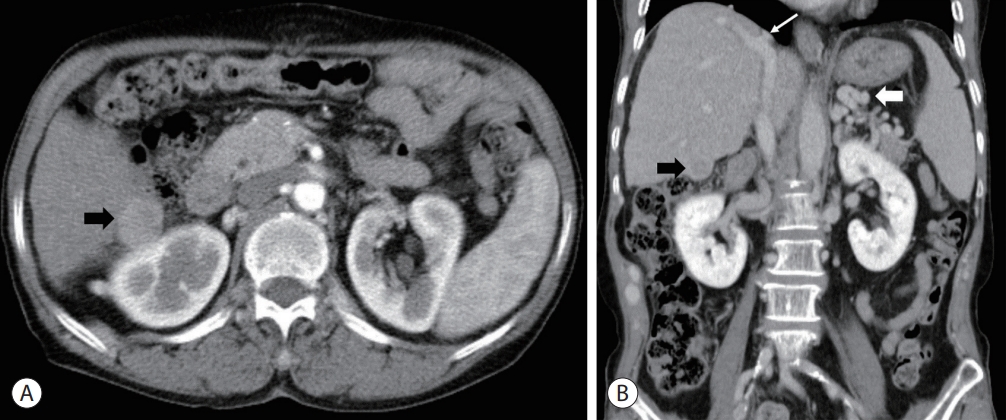
- Membranous obstruction of the inferior vena cava (MOVC) is a rare subset of Budd-Chiari syndrome (BCS) with a subacute onset that is often complicated by cirrhosis and hepatocellular carcinoma (HCC). Here we report a case of recurrent HCC in a patient with cirrhosis and BCS that was treated with several episodes of transarterial chemoembolization followed by surgical tumorectomy, whereas the MOVC was successfully treated with balloon angioplasty followed by endovascular stenting. The patient was followed up for 9.9 years without anticoagulation and experienced no stent thrombosis. After the tumorectomy, the patient was HCC-free for 4.4 years of follow-up.
-
Citations
Citations to this article as recorded by- Multidisciplinary collaboration successfully treated Budd Chiari syndrome complicated with hepatocellular carcinoma rupture and bleeding: A case report
Lian Liao, Yuyang Qiu, Xiaobo Gong
Medicine.2025; 104(51): e46748. CrossRef
- Multidisciplinary collaboration successfully treated Budd Chiari syndrome complicated with hepatocellular carcinoma rupture and bleeding: A case report
 First
 Prev




 Follow JLC on Twitter

