
 E-submission
 Get new issue alerts
 THE KOREAN LIVER CANCER ASSOCIATION

Search
- Page Path
- HOME > Search
Review Article
- Toward a future role for liver biopsy in HCC: literature evidence and survey-based perspectives from Korean experts
- Hae Lim Lee, Su Jong Yu, Sung Hak Lee, Min Woo Lee, Han Ah Lee, Yuri Cho, Jeong-Ju Yoo, Ha Il Kim, Jae Geun Lee, Hye Won Lee, Jihyun An, Sun Young Yim, Pil Soo Sung, Jonggi Choi, Jae Hyun Yoon, Eun Ju Cho, Jinhong Jung, Dongho Hyun, Ijin Joo, Yu Rim Lee, YoungRok Choi, Bo Hyun Kim, Sung Hyun Kim, Soon Sun Kim, Jeong-Han Kim, Haeryoung Kim, Pyoung-Jae Park, Hyun Phil Shin, Ki Tae Yoon, Sang Min Yoon, Minjong Lee, Jai Young Cho, Jin-Young Choi, Do Young Kim, June Sung Lee, Mi-Sook Kim, Kyung Sik Kim
- J Liver Cancer. 2026;26(2):205-219. Published online September 3, 2026
- DOI: https://doi.org/10.17998/jlc.2026.08.27

- 1,191 Views
- 66 Downloads
-
 Abstract
 PDF
 Supplementary Material
- The role of liver biopsy in hepatocellular carcinoma (HCC) is being re-evaluated in the era of precision oncology and biomarker-driven systemic therapy. Although histopathological examination remains the diagnostic gold standard, HCC is unique among solid tumors in that accurate non-invasive imaging criteria allow diagnosis without routine biopsy in selected clinical settings. However, increasing biological heterogeneity, expanding therapeutic options, and the growing need for molecular stratification have renewed interest in tissue-based evaluation. Recent international guidelines have gradually broadened the indications for liver biopsy, particularly in selected diagnostic scenarios, prior to systemic therapy, and for molecular profiling. Beyond diagnostic confirmation, liver biopsy provides important information for histological subtyping, prognostic stratification, and biomarker discovery. Advances in immunohistochemistry, next-generation sequencing, and artificial intelligence-assisted pathology have further enhanced the clinical value of tumor tissue. In parallel, contemporary cohort studies indicate that liver biopsy is associated with low complication rates when modern techniques and standardized peri-procedural management are applied. Despite these advances, the integration of liver biopsy into routine clinical practice remains limited. To contextualize this gap, the Korean Liver Cancer Association conducted a nationwide survey of HCC specialists. The survey showed that liver biopsy is infrequently performed in current practice due to perceived procedural risks and limited immediate impact on therapeutic decision-making. Taken together, accumulating evidence supports a reappraisal of the clinical role of liver biopsy in HCC. Optimizing procedural safety, standardizing indications, and integrating tissue-based molecular insights into therapeutic decision-making may help bridge the gap between emerging evidence and real-world practice.

Special Contribution
- Impact of the 2024 medical-policy conflict on hepatocellular carcinoma management in Korea
- Soon Sun Kim, Hyun Yang, Jieun Kwon, Eunju Kim, Jeong Il Yu, Janghan Jung, Woosun Choi, Ji Eun Han, Moon Haeng Hur, Bo Hyun Kim, Sung Hyun Kim, Jeong Han Kim, Haeryoung Kim, Pyoung-Jae Park, Hyun Phil Shin, Su Jong Yu, Ki Tae Yoon, Sang Min Yoon, Minjong Lee, Jai Young Cho, Jin-Young Choi, Do Young Kim, June Sung Lee, Mi-Sook Kim, Kyung Sik Kim
- J Liver Cancer. 2025;25(2):169-177. Published online September 2, 2025
- DOI: https://doi.org/10.17998/jlc.2025.09.01

- 3,879 Views
- 91 Downloads
-
Abstract
PDF
- In 2024, a nationwide conflict between the South Korean government and the medical community, the medical-policy conflict, profoundly impacted healthcare delivery. This study aimed to evaluate the changes in the management of hepatocellular carcinoma (HCC) following this crisis. We analyzed retrospective real-world data from university hospitals in the Seoul Metropolitan Area, supplemented with national healthcare data from the Health Insurance Review and Assessment Service. The analytical variables included changes in workforce composition, initial treatment modalities, HCC stage distribution, quality indicators for HCC care, regional and institutional variations in care delivery, and liver transplantation (LT) volume. A comparison between 2023 and 2024 revealed a marked decline in the number of medical trainees, a rise in the proportion of physician assistants, a 28.9% reduction in newly initiated HCC treatments, and an increased rate of stage IV diagnoses. Several quality indicators, including rates of multidisciplinary care and patient education, declined. The volume of LTs decreased by approximately 20% nationwide, with some regions ceasing LT procedures. The results suggest that serious disruptions occurred in HCC care following the conflict. The significant decrease in initial treatment and number of LT procedures, more advanced stages at diagnosis, and declining quality metrics indicate the emergence of healthcare gaps. Without the recovery of the clinical workforce and the reestablishment of a stable healthcare delivery system, the management of serious diseases such as HCC will remain structurally vulnerable. National-level efforts are urgently required to address regional disparities and restore essential medical services.
Review Articles
- Evolving roles of systemic therapy in hepatocellular carcinoma: neoadjuvant and adjuvant strategies
- Ho Soo Chun, Minjong Lee, Tae Hun Kim
- J Liver Cancer. 2025;25(2):178-186. Published online June 16, 2025
- DOI: https://doi.org/10.17998/jlc.2025.06.13

- 8,907 Views
- 213 Downloads
- 2 Web of Science
- 3 Citations
-
Abstract
PDF
- Surgical resection for early-stage hepatocellular carcinoma (HCC) provides the potential for long-term survival but recurrence rates within 5 years were up to 70%. Thus, neoadjuvant or adjuvant strategies can be important to improve outcomes. Previous efforts with sorafenib in the adjuvant setting failed to show significant benefits in recurrence-free survival (RFS) or overall survival. However, developments in systemic therapies such as immune checkpoint inhibitors or tyrosine kinase inhibitors have revitalized this field. Although the IMBrave050 trial failed to demonstrate a significant improvement in RFS with one year of adjuvant treatment using atezolizumab combined with bevacizumab in high-risk patients treated with resection or ablation, several other ongoing trials are investigating this promising approach. Neoadjuvant or adjuvant approach using systemic therapies is also gaining attention, supported by phase 1 or 2 clinical trials indicating high objective response rates. In addition, systemic therapies are being increasingly studied as down-staging strategies for resection or liver transplantation. The growing complexity of HCC treatment such as the integration of neoadjuvant and adjuvant strategies underscores the importance of a multidisciplinary approach to optimize therapeutic decision-making in this evolving areas.
-
Citations
Citations to this article as recorded by
- Adjuvant cytokine-induced killer cell immunotherapy in hepatocellular carcinoma: real-world data and 9-year extended follow-up of a randomized controlled trial
Hyunjae Shin, Youngsu Park, Byeong Geun Song, Won-Mook Choi, Hyung Joon Han, Youngwoo Lee, Tae-Jin Song, Jong-Eun Yeon, Young-Suk Lim, Moon Haeng Hur, Yun Bin Lee, Eun Ju Cho, Su Jong Yu, Yoon Jun Kim, Joon Hyeok Lee, Jung-Hwan Yoon, Jeong-Hoon Lee
Cancer Immunology, Immunotherapy.2026;[Epub] CrossRef - Regorafenib as Second-Line Versus Later-Line Therapy in Advanced Hepatocellular Carcinoma: A Multicenter Real-World Study with Exploratory Analysis of Prior Immune Checkpoint Inhibitor Exposure
Kwon Yong Tak, Hee Sun Cho, Jaejun Lee, Kyeungmo Yang, Ahlim Lee, Ji Won Han, Soon Kyu Lee, Hyun Yang, Heechul Nam, Hee Yeon Kim, Sung Won Lee, Seok-Hwan Kim, Do Seon Song, Myeong Jun Song, Jung Hyun Kwon, UIm Chang, Soon Woo Nam, Chang Wook Kim, Jeong Wo
Targeted Oncology.2026; 21(5): 761. CrossRef - The Gut–Liver IgA Axis in Liver Disease: From Mucosal Immunity to Hepatic Inflammation and Cancer
Sung Woo Cho, Gil Won Lee, Pil Soo Sung
Cells.2026; 15(21): 1933. CrossRef
- Adjuvant cytokine-induced killer cell immunotherapy in hepatocellular carcinoma: real-world data and 9-year extended follow-up of a randomized controlled trial
- Is Transarterial Chemoembolization Only Treatment Option in Patients with Intermediate Stage of Hepatocellular Carcinoma?: in Perspectives of Surgery
- Ji Young Lim, Minjong Lee, Tae Hun Kim
- J Liver Cancer. 2020;20(2):113-119. Published online September 30, 2020
- DOI: https://doi.org/10.17998/jlc.20.2.113
- 9,483 Views
- 149 Downloads
- 1 Citation
-
Abstract
PDF
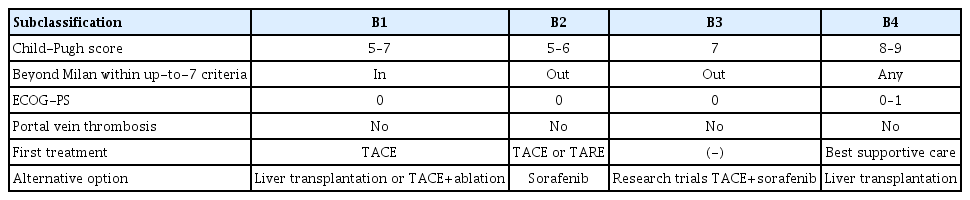
- In the Barcelona Clinic Liver Cancer staging system, intermediate stage hepatocellular carcinoma (HCC) is defined as large multinodular tumors without vascular invasion or extrahepatic spread in an asymptomatic patient with good performance status. Intermediate stage HCC includes various subgroups and it is characterized by extensive heterogeneity. Current guidelines recommend transarterial chemoembolization (TACE) as the standard treatment modality for patients with intermediate stage HCC. Although TACE provides improved survival benefits compared with supportive care for patients with intermediate stage HCC, all of them are not good candidates for TACE. TACE refractoriness is another obstacle to effective treatment of patients with intermediate stage HCC. Given that many studies recently reported improved survival in patients treated with hepatic resection over TACE, we reviewed the survival outcomes of TACE and hepatic resection as a treatment strategy of intermediate stage HCC.
-
Citations
Citations to this article as recorded by- Noninvasive Prediction of High Ki-67 Expression in Hepatocellular Carcinoma Using Multiparametric MRI and Clinical Biomarkers
Fan Zhang, Gen Chen, Mengqi Huang, Yang Yang, Zixiong Wang, Yaqi Shen, Yan Luo, Xuemei Hu, Zhen Li
Journal of Hepatocellular Carcinoma.2026; Volume 13: 1. CrossRef
- Noninvasive Prediction of High Ki-67 Expression in Hepatocellular Carcinoma Using Multiparametric MRI and Clinical Biomarkers
 First
 Prev




 Follow JLC on Twitter

