
 E-submission
 Get new issue alerts
 THE KOREAN LIVER CANCER ASSOCIATION

Search
- Page Path
- HOME > Search
Review Article
- Toward a future role for liver biopsy in HCC: literature evidence and survey-based perspectives from Korean experts
- Hae Lim Lee, Su Jong Yu, Sung Hak Lee, Min Woo Lee, Han Ah Lee, Yuri Cho, Jeong-Ju Yoo, Ha Il Kim, Jae Geun Lee, Hye Won Lee, Jihyun An, Sun Young Yim, Pil Soo Sung, Jonggi Choi, Jae Hyun Yoon, Eun Ju Cho, Jinhong Jung, Dongho Hyun, Ijin Joo, Yu Rim Lee, YoungRok Choi, Bo Hyun Kim, Sung Hyun Kim, Soon Sun Kim, Jeong-Han Kim, Haeryoung Kim, Pyoung-Jae Park, Hyun Phil Shin, Ki Tae Yoon, Sang Min Yoon, Minjong Lee, Jai Young Cho, Jin-Young Choi, Do Young Kim, June Sung Lee, Mi-Sook Kim, Kyung Sik Kim
- J Liver Cancer. 2026;26(2):205-219. Published online September 3, 2026
- DOI: https://doi.org/10.17998/jlc.2026.08.27

- 1,192 Views
- 66 Downloads
-
 Abstract
 PDF
 Supplementary Material
- The role of liver biopsy in hepatocellular carcinoma (HCC) is being re-evaluated in the era of precision oncology and biomarker-driven systemic therapy. Although histopathological examination remains the diagnostic gold standard, HCC is unique among solid tumors in that accurate non-invasive imaging criteria allow diagnosis without routine biopsy in selected clinical settings. However, increasing biological heterogeneity, expanding therapeutic options, and the growing need for molecular stratification have renewed interest in tissue-based evaluation. Recent international guidelines have gradually broadened the indications for liver biopsy, particularly in selected diagnostic scenarios, prior to systemic therapy, and for molecular profiling. Beyond diagnostic confirmation, liver biopsy provides important information for histological subtyping, prognostic stratification, and biomarker discovery. Advances in immunohistochemistry, next-generation sequencing, and artificial intelligence-assisted pathology have further enhanced the clinical value of tumor tissue. In parallel, contemporary cohort studies indicate that liver biopsy is associated with low complication rates when modern techniques and standardized peri-procedural management are applied. Despite these advances, the integration of liver biopsy into routine clinical practice remains limited. To contextualize this gap, the Korean Liver Cancer Association conducted a nationwide survey of HCC specialists. The survey showed that liver biopsy is infrequently performed in current practice due to perceived procedural risks and limited immediate impact on therapeutic decision-making. Taken together, accumulating evidence supports a reappraisal of the clinical role of liver biopsy in HCC. Optimizing procedural safety, standardizing indications, and integrating tissue-based molecular insights into therapeutic decision-making may help bridge the gap between emerging evidence and real-world practice.

Original Article
- Hepatocellular carcinoma in Korea: an analysis of the 2016-2018 Korean Nationwide Cancer Registry
- Jihyun An, Young Chang, Gwang Hyeon Choi, Won Sohn, Jeong Eun Song, Hyunjae Shin, Jae Hyun Yoon, Jun Sik Yoon, Hye Young Jang, Eun Ju Cho, Ji Won Han, Suk Kyun Hong, Ju-Yeon Cho, Kyu-Won Jung, Eun Hye Park, Eunyang Kim, Bo Hyun Kim
- J Liver Cancer. 2025;25(1):109-122. Published online March 4, 2025
- DOI: https://doi.org/10.17998/jlc.2025.02.20

- 8,727 Views
- 217 Downloads
- 7 Web of Science
- 8 Citations
-
Abstract
PDFSupplementary Material
- Backgrounds/Aims
Hepatocellular carcinoma (HCC) is the sixth most common cancer and second leading cause of cancer-related deaths in South Korea. This study evaluated the characteristics of Korean patients newly diagnosed with HCC in 2016-2018.
Methods
Data from the Korean Primary Liver Cancer Registry (KPLCR), a representative database of patients newly diagnosed with HCC in South Korea, were analyzed. This study investigated 4,462 patients with HCC registered in the KPLCR in 2016-2018.
Results
The median patient age was 63 years (interquartile range, 55-72). 79.7% of patients were male. Hepatitis B infection was the most common underlying liver disease (54.5%). The Barcelona Clinic Liver Cancer (BCLC) staging system classified patients as follows: stage 0 (14.9%), A (28.8%), B (7.5%), C (39.0%), and D (9.8%). The median overall survival was 3.72 years (95% confidence interval, 3.47-4.14), with 1-, 3-, and 5-year overall survival rates of 71.3%, 54.1%, and 44.3%, respectively. In 2016-2018, there was a significant shift toward BCLC stage 0-A and Child-Turcotte-Pugh liver function class A (P<0.05), although survival rates did not differ by diagnosis year. In the treatment group (n=4,389), the most common initial treatments were transarterial therapy (31.7%), surgical resection (24.9%), best supportive care (18.9%), and local ablation therapy (10.5%).
Conclusions
Between 2016 and 2018, HCC tended to be diagnosed at earlier stages, with better liver function in later years. However, since approximately half of the patients remained diagnosed at an advanced stage, more rigorous and optimized HCC screening strategies should be implemented. -
Citations
Citations to this article as recorded by
- Nutritional Risk Assessed by Royal Free Hospital-Nutritional Prioritizing Tool Predicts Survival in Cirrhosis With or Without Hepatocellular Carcinoma
Hyun Joon Park, Jin Kyu Jung, Jeonghwan Noh, Yeonsu Kim, Sang Uk Lee, Byung Cheol Yun, Jung Wook Lee, Hyung Jun Kim, Kwang Il Seo
Journal of Korean Medical Science.2026;[Epub] CrossRef - The Role of MicroRNAs in Hepatocellular Carcinoma: From Tumorigenesis to Biomarker Applications
Hyunjin Park, Seunghye Kim, Jeong Eun Yoo, Haeryoung Kim
Journal of Digestive Cancer Research.2026; 14(1): 93. CrossRef - Real-world outcomes of atezolizumab–bevacizumab and durvalumab–tremelimumab in unresectable hepatocellular carcinoma: a systematic review with covariate-adjusted meta-regression and exploratory machine learning analysis
Jongin Lee, Kwon Yong Tak, Hee Sun Cho, Jaejun Lee, Keungmo Yang, Pil Soo Sung, Jeong Won Jang, Ji Won Han
Frontiers in Immunology.2026;[Epub] CrossRef - Stereotactic body radiation therapy for hepatocellular carcinoma: 2026 expert consensus-based practical recommendation of the Korean Liver Cancer Association
Jinhong Jung, Han Ah Lee, Do Young Kim, Hyun-Cheol Kang, Sun Hyun Bae, Ji Hye Min, Gyu Sang Yoo, Jeong Il Yu, Seo Hee Choi, Hae Lim Lee, Subin Heo, Chai Hong Rim, Sang Min Yoon, June Sung Lee
Radiation Oncology Journal.2026; 44(3): 151. CrossRef - Outcomes of early-stage hepatocellular carcinoma patients treated by resection or ablation: real-life data from the French Administrative Health Care database
Marie Decraecker, Boris Guiu, Emmanuel Boleslawski, Pierre Nahon, Manel Dhaoui, Danko Stamenic, Moreau Manoel, Alicia Fravalo, Jean Frédéric Blanc
Journal of Liver Cancer.2026; 26(2): 275. CrossRef - Stereotactic body radiation therapy for hepatocellular carcinoma: 2026 expert consensus-based practical recommendation of the Korean Liver Cancer Association
Jinhong Jung, Han Ah Lee, Do Young Kim, Hyun-Cheol Kang, Sun Hyun Bae, Ji Hye Min, Gyu Sang Yoo, Jeong Il Yu, Seo Hee Choi, Hae Lim Lee, Subin Heo, Chai Hong Rim, Sang Min Yoon, June Sung Lee
Journal of Liver Cancer.2026; 26(2): 182. CrossRef - From practical consensus to clinical integration: positioning stereotactic body radiation therapy in the contemporary management of hepatocellular carcinoma
Nalee Kim
Journal of Liver Cancer.2026; 26(2): 179. CrossRef - Real-World Treatment Efficacy and Safety Profile of Sofosbuvir- and Velpatasvir-Based HCV Treatment in South Korea: Multicenter Prospective Study
Jae Hyun Yoon, Chang Hun Lee, Hoon Gil Jo, Ju-Yeon Cho, Jin Dong Kim, Jin Won Kim, Ga Ram You, Sung Bum Cho, Sung Kyu Choi
Viruses.2025; 17(7): 949. CrossRef
- Nutritional Risk Assessed by Royal Free Hospital-Nutritional Prioritizing Tool Predicts Survival in Cirrhosis With or Without Hepatocellular Carcinoma
Review Article
- Management of early-stage hepatocellular carcinoma: challenges and strategies for optimal outcomes
- Jae Hyun Yoon, Sung Kyu Choi
- J Liver Cancer. 2023;23(2):300-315. Published online September 21, 2023
- DOI: https://doi.org/10.17998/jlc.2023.08.27
- 25,622 Views
- 365 Downloads
- 27 Citations
-
Abstract
PDF
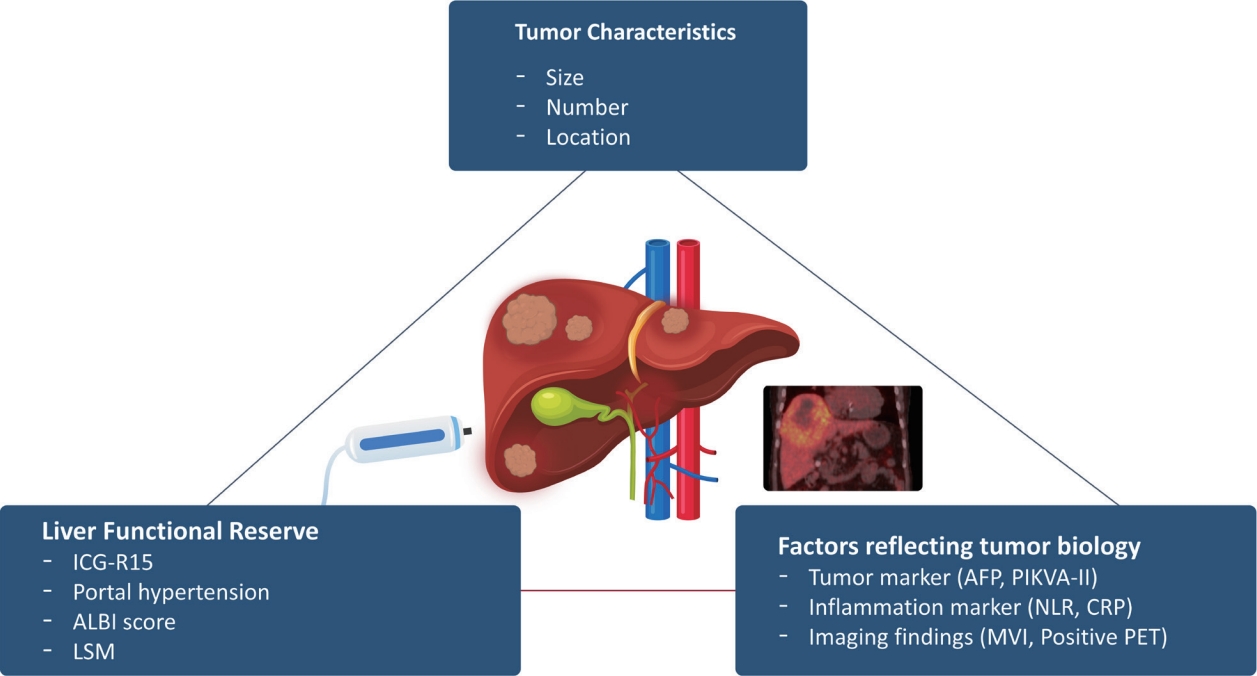
- Although hepatocellular carcinoma (HCC) is associated with a poor prognosis, management of early-stage HCC is often successful with highly efficacious treatment modalities such as liver transplantation, surgical resection, and radiofrequency ablation. However, unfavorable clinical outcomes have been observed under certain circumstances, even after efficient treatment. Factors that predict unsuitable results after treatment include tumor markers, inflammatory markers, imaging findings reflecting tumor biology, specific outcome indicators for each treatment modality, liver functional reserve, and the technical feasibility of the treatment modalities. Various strategies may overcome these challenges, including the application of reinforced treatment indication criteria with predictive markers reflecting tumor biology, compensation for technical issues with up-to-date technologies, modification of treatment modalities, downstaging with locoregional therapies (such as transarterial chemotherapy or radiotherapy), and recently introduced combination immunotherapies. In this review, we discuss the challenges to achieving optimal outcomes in the management of early-stage HCC and suggest strategies to overcome these obstacles.
-
Citations
Citations to this article as recorded by- NSUN3-Mediated ROS Accumulation Promotes Hepatocellular Carcinoma Proliferation and Activates PI3K/AKT Pathway
Haodong Liu, Shijie Liang, Chunting Peng, Jiawei Yang, Zheng Yang, Wuning Mo
Biochemical Genetics.2026; 64(2): 2782. CrossRef - Let-7a and miR-34a Interplay Potent Suppressive Roles in Hepatocellular Carcinoma via Co-Targeting FNDC3B, IGF2 and SOX4
Bangly Soliman, Ahmed Fawzy Ibrahim, Ahmed Salem, Mohamed Ghazy, Mahmoud T. Abo-Elfadl, Mahmoud ElHefnawi, Mario Flores
International Journal of Molecular Sciences.2026; 27(4): 1714. CrossRef - Association between periodontitis and hepatocellular carcinoma across different tumor stages
Liangqiuyue Zhong, Wenjing Wang, Yunshan Zhao, Chunshen Li, Pengyu Chen, Yan Liu, Xiaogang Zhang, Xi Chen
BMC Oral Health.2026;[Epub] CrossRef - Hepatocellular carcinoma and vitamin D metabolism: novel targets and therapeutic strategies
Hanlin Gao, Li He, Zhi Chen, Gang Wang
Cellular Oncology.2026;[Epub] CrossRef - Design, synthesis, and mechanistic study of bispecific small molecules-based phenyl pyrazolopyrimidinone scaffold as dual-targeting VEGFR and PD-L1 immune checkpoint in hepatocellular carcinoma
Esraa.M.M. Hassoub, Bahgat R.M. Hussein, Mamdouh F.A. Mohamed, El-Shimaa M.N. Abdelhafez
Bioorganic Chemistry.2026; 175: 109789. CrossRef - Clinical nursing pathways and psychological care in early liver cancer surgery patients: Effects on anxiety, depression, and pain
Ting Zhang, Hong-Xia Liang, Li-Dong Cao, Shuang-Shuang Hu
World Journal of Psychiatry.2026;[Epub] CrossRef - Agomelatine versus gefitinib against HepG2 cells: Modulating PI3K/AKT and MAPK/RAF1/c-FOS pathways
Heba M. Abd El Kareem, Sara F. Saadawy, Mai M. ELdaly, Yousef Al-Saraireh, Heba A. Hassan
Molecular Biology Reports.2026;[Epub] CrossRef - Computational Unveiling of the Mechanism of Action of Selected Steroidal Saponins from Trillium tschonoskii as Potential Anti-hepatocarcinoma Agents
Hung Duc Nguyen
Russian Journal of Physical Chemistry A.2026; 100(5): 1037. CrossRef - Current advances in nanoparticle-based approaches for the hepatocellular carcinoma treatment
Sathishbabu Paranthaman, Umme Hani, Riyaz Ali M. Osmani, Rohit R. Bhosale, Nazima Haider
Clinics and Research in Hepatology and Gastroenterology.2025; 49(1): 102508. CrossRef - Therapeutic potential of kakkatin derivatives against hepatocellular carcinoma
Sahiba Chahal, Vikram Patial
World Journal of Clinical Oncology.2025;[Epub] CrossRef - Sequential combination with ropeginterferon alfa-2b and anti-PD-1 treatment as adjuvant therapy in HBV-related HCC: a phase 1 dose escalation trial
Albert Qin, Ming-Chih Ho, Chan-Yen Tsai, Chun-Jen Liu, Pei-Jer Chen
Hepatology International.2025; 19(3): 547. CrossRef - Advancing Cancer Treatment: A Review of Immune Checkpoint Inhibitors and Combination Strategies
Valencia Mc Neil, Seung Won Lee
Cancers.2025; 17(9): 1408. CrossRef - Comparison of initial treatments for resectable hepatocellular carcinoma within Milan criteria: an observational study based on a nationwide survey
Sang Jin Kim, Woo Kyoung Jeong, Hyung-Joon Han, Gyu-Seong Choi, Kyun-Hwan Kim, Jongman Kim
Annals of Surgical Treatment and Research.2025; 108(5): 279. CrossRef - Locoregional Therapies for Hepatocellular Carcinoma with Portal Vein Tumor Thrombus
Ramanpreet Singh, Mina S. Makary
Journal of Gastrointestinal Cancer.2025;[Epub] CrossRef - Pre- and postoperative predictors of extrahepatic recurrence after curative resection for hepatocellular carcinoma
Chang Hun Lee, Yun Chae Lee, Seung Young Seo, Ga Ram You, Hoon Gil Jo, Sung Bum Cho, Eun Young Cho, In Hee Kim, Sung Kyu Choi, Jae Hyun Yoon
BMC Cancer.2025;[Epub] CrossRef - Escin inhibits PD-L1 expression by suppressing the p38 MAPK/ERK signalling pathways and synergistically enhances PD-1 inhibitor efficacy in hepatocellular carcinoma
Yue Yuan, Ping Wang, Shirong Chen, Zihan Cao, Suvash Chandra Ojha, Changfeng Sun, Gan Wang, Zenglu Wang, Jintao Gu, Jiefang Kang, Xiaochang Xue
Phytomedicine.2025; 149: 157532. CrossRef - Diosgenin potentiates the anticancer effect of doxorubicin and volasertib via regulating polo-like kinase 1 and triggering apoptosis in hepatocellular carcinoma cells
Eman H. Yousef, Mohamed E. El-Mesery, Maha R. Habeeb, Laila A. Eissa
Naunyn-Schmiedeberg's Archives of Pharmacology.2024; 397(7): 4883. CrossRef - Comparison of Surgical Resection and Radiofrequency Ablation in Elderly Patients with Hepatocellular Carcinoma
Jun Il Kim, Jayoun Lee, Gi Hong Choi, Min Woo Lee, Dong Ah Park, Jeong-Ju Yoo
Digestive Diseases and Sciences.2024; 69(3): 1055. CrossRef - Radiofrequency for hepatocellular carcinoma larger than 3 cm: potential for applications in daily practice
Ji Hoon Kim, Pil Soo Sung
Journal of Liver Cancer.2024; 24(1): 1. CrossRef - Hepatocellular carcinoma outcomes and potential implications for surveillance in elderly patients
Aryoung Kim, Goeun Park, Myung Ji Goh, Byeong Geun Song, Wonseok Kang, Geum-Youn Gwak, Yong-Han Paik, Moon Seok Choi, Joon Hyeok Lee, Dong Hyun Sinn
Scientific Reports.2024;[Epub] CrossRef - Trends in alcohol use and alcoholic liver disease in South Korea: a nationwide cohort study
Jeong-Ju Yoo, Dong Hyeon Lee, Young Chang, Hoongil Jo, Young Youn Cho, Sangheun Lee, Log Young Kim, Jae Young Jang
BMC Public Health.2024;[Epub] CrossRef - Machine learning model reveals roles of interferon‑stimulated genes in sorafenib‑resistant liver cancer
Deok Seo, Ji Park, Hee Jung, Min Kang, Byung Kang, Dong Lee, Jae Lee, Seung Yoon, Jeong Jang, Jae Ahn, Pil Sung
Oncology Letters.2024;[Epub] CrossRef - Heavy smoking increases early mortality risk in patients with hepatocellular carcinoma after curative treatment
Jaejun Lee, Jong Young Choi, Soon Kyu Lee
Journal of Liver Cancer.2024; 24(2): 253. CrossRef - Superselective ablative chemo-ethanol embolization for recurrent single hepatocellular carcinoma: a 6-month outcome analysis
Jae Hwan Lee, Kun Yung Kim, Chong-ho Lee, Minuk Kim, Chang Jin Yoon
Journal of Liver Cancer.2024; 24(2): 217. CrossRef - Bridging hope: Retrospective analysis of stereotactic radiotherapy in patients with hepatocellular carcinoma-A promising and cost-effective solution for low-and middle-income countries
Rakesh Kapoor, Treshita Dey, Divya Khosla, Sunil Taneja, Naveen Kalra, Rajesh Gupta
Cancer Research, Statistics, and Treatment.2024; 7(3): 326. CrossRef - Stage dependent microbial dynamics in hepatocellular carcinoma and adjacent normal liver tissues
Hee Eun Jo, Sophallika Khom, Sumi Lee, Su Hyeon Cho, Shin Young Park, Ga Ram You, Hyosin Kim, Nah Ihm Kim, Jae-Ho Jeong, Jae Hyun Yoon, Misun Yun
Scientific Reports.2024;[Epub] CrossRef - Efficacy of Transarterial Chemoembolization (TACE) for Early-Stage Hepatocellular Carcinoma
Moonhyung Lee, Hyun Phil Shin
Medicina.2023; 59(12): 2174. CrossRef
- NSUN3-Mediated ROS Accumulation Promotes Hepatocellular Carcinoma Proliferation and Activates PI3K/AKT Pathway
 First
 Prev




 Follow JLC on Twitter

