
 E-submission
 Get new issue alerts
 THE KOREAN LIVER CANCER ASSOCIATION

Search
- Page Path
- HOME > Search
Review Article
- Toward a future role for liver biopsy in HCC: literature evidence and survey-based perspectives from Korean experts
- Hae Lim Lee, Su Jong Yu, Sung Hak Lee, Min Woo Lee, Han Ah Lee, Yuri Cho, Jeong-Ju Yoo, Ha Il Kim, Jae Geun Lee, Hye Won Lee, Jihyun An, Sun Young Yim, Pil Soo Sung, Jonggi Choi, Jae Hyun Yoon, Eun Ju Cho, Jinhong Jung, Dongho Hyun, Ijin Joo, Yu Rim Lee, YoungRok Choi, Bo Hyun Kim, Sung Hyun Kim, Soon Sun Kim, Jeong-Han Kim, Haeryoung Kim, Pyoung-Jae Park, Hyun Phil Shin, Ki Tae Yoon, Sang Min Yoon, Minjong Lee, Jai Young Cho, Jin-Young Choi, Do Young Kim, June Sung Lee, Mi-Sook Kim, Kyung Sik Kim
- J Liver Cancer. 2026;26(2):205-219. Published online September 3, 2026
- DOI: https://doi.org/10.17998/jlc.2026.08.27

- 561 Views
- 40 Downloads
-
 Abstract
 PDF
- The role of liver biopsy in hepatocellular carcinoma (HCC) is being re-evaluated in the era of precision oncology and biomarker-driven systemic therapy. Although histopathological examination remains the diagnostic gold standard, HCC is unique among solid tumors in that accurate non-invasive imaging criteria allow diagnosis without routine biopsy in selected clinical settings. However, increasing biological heterogeneity, expanding therapeutic options, and the growing need for molecular stratification have renewed interest in tissue-based evaluation. Recent international guidelines have gradually broadened the indications for liver biopsy, particularly in selected diagnostic scenarios, prior to systemic therapy, and for molecular profiling. Beyond diagnostic confirmation, liver biopsy provides important information for histological subtyping, prognostic stratification, and biomarker discovery. Advances in immunohistochemistry, next-generation sequencing, and artificial intelligence-assisted pathology have further enhanced the clinical value of tumor tissue. In parallel, contemporary cohort studies indicate that liver biopsy is associated with low complication rates when modern techniques and standardized peri-procedural management are applied. Despite these advances, the integration of liver biopsy into routine clinical practice remains limited. To contextualize this gap, the Korean Liver Cancer Association conducted a nationwide survey of HCC specialists. The survey showed that liver biopsy is infrequently performed in current practice due to perceived procedural risks and limited immediate impact on therapeutic decision-making. Taken together, accumulating evidence supports a reappraisal of the clinical role of liver biopsy in HCC. Optimizing procedural safety, standardizing indications, and integrating tissue-based molecular insights into therapeutic decision-making may help bridge the gap between emerging evidence and real-world practice.

Special Contribution
- Stereotactic body radiation therapy for hepatocellular carcinoma: 2026 expert consensus-based practical recommendation of the Korean Liver Cancer Association
- Jinhong Jung, Han Ah Lee, Do Young Kim, Hyun-Cheol Kang, Sun Hyun Bae, Ji Hye Min, Gyu Sang Yoo, Jeong Il Yu, Seo Hee Choi, Hae Lim Lee, Subin Heo, Chai Hong Rim, Sang Min Yoon, June Sung Lee
- J Liver Cancer. 2026;26(2):182-204. Published online September 2, 2026
- DOI: https://doi.org/10.17998/jlc.2026.08.22

- 623 Views
- 90 Downloads
-
Abstract
PDF
- Stereotactic body radiation therapy (SBRT) is a noninvasive, high-precision radiation technique that delivers a high dose to the tumor in a limited number of fractions, typically five or fewer, and is increasingly used as a curative-intent option for hepatocellular carcinoma (HCC), particularly when surgical resection, liver transplantation, or local ablative therapies are not feasible. Although domestic and international guidelines have incorporated SBRT into the treatment algorithm for HCC, the lack of comprehensive evidence and expert opinion regarding patient selection, pretreatment evaluation, treatment planning and delivery, complication management, and post-treatment follow-up has resulted in substantial variation in clinical practice. Accordingly, expert consensus-based practical recommendations for SBRT were developed by a group of radiation oncologists, hepatologists, and radiologists from the Research Committee of the Korean Liver Cancer Association, based on expert surveys, a comprehensive review of evidence-based literature, and a modified Delphi process. Encompassing the entire clinical workflow of liver SBRT, these recommendations are intended to provide practical guidance for the safe and effective implementation of SBRT in patients with HCC.
Original Article
- The efficacy of treatment for hepatocellular carcinoma in elderly patients
- Han Ah Lee, Sangheun Lee, Hae Lim Lee, Jeong Eun Song, Dong Hyeon Lee, Sojung Han, Ju Hyun Shim, Bo Hyun Kim, Jong Young Choi, Hyunchul Rhim, Do Young Kim
- J Liver Cancer. 2023;23(2):362-376. Published online September 14, 2023
- DOI: https://doi.org/10.17998/jlc.2023.08.03
- 9,167 Views
- 167 Downloads
- 12 Citations
-
Abstract
PDF
 Supplementary Material
- Background/Aim
Despite the increasing proportion of elderly patients with hepatocellular carcinoma (HCC) over time, treatment efficacy in this population is not well established.
Methods
Data collected from the Korean Primary Liver Cancer Registry, a representative cohort of patients newly diagnosed with HCC in Korea between 2008 and 2017, were analyzed. Overall survival (OS) according to tumor stage and treatment modality was compared between elderly and non-elderly patients with HCC.
Results
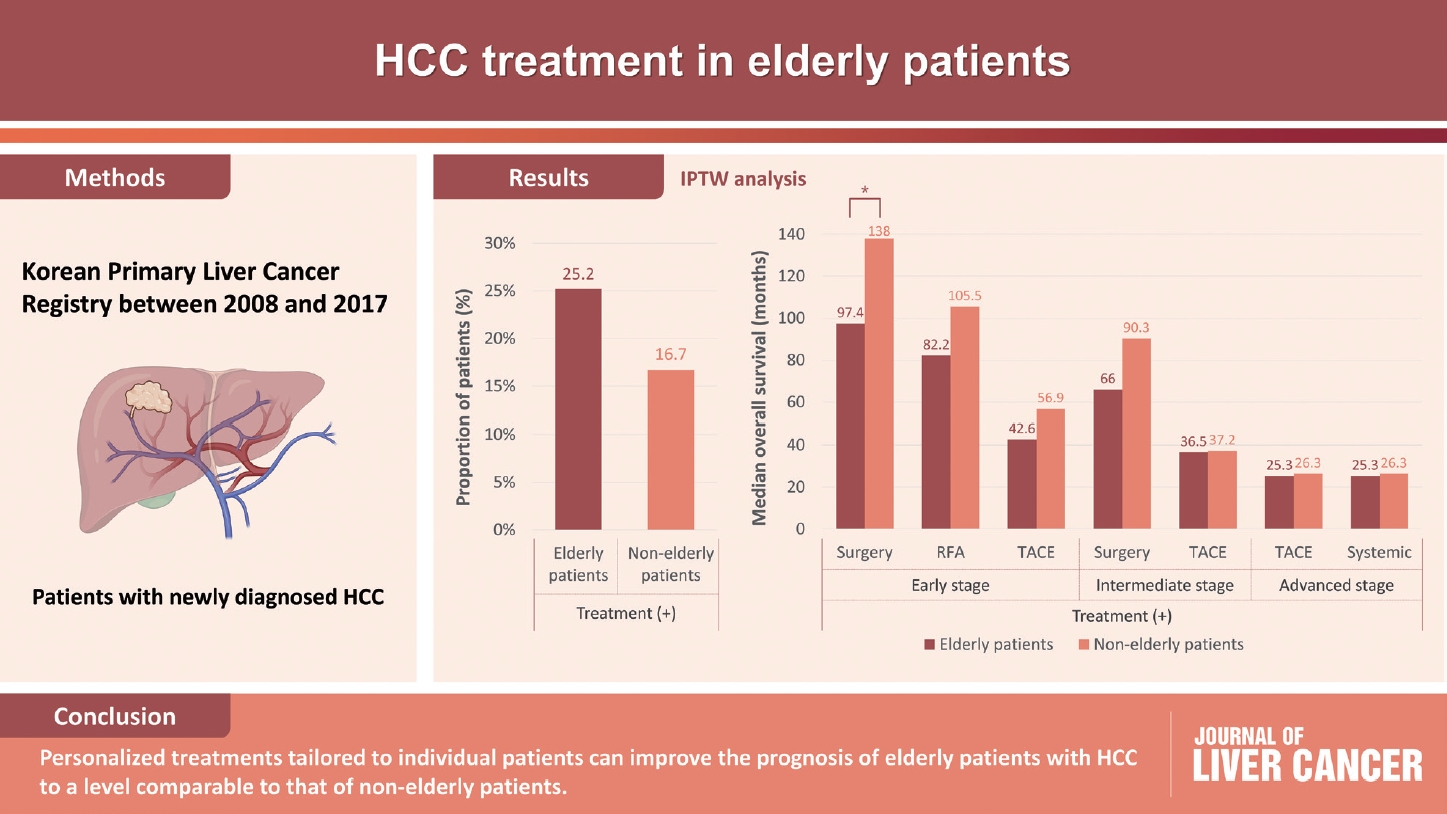
Among 15,186 study patients, 5,829 (38.4%) were elderly. A larger proportion of elderly patients did not receive any treatment for HCC than non-elderly patients (25.2% vs. 16.7%). However, OS was significantly better in elderly patients who received treatment compared to those who did not (median, 38.6 vs. 22.3 months; P<0.001). In early-stage HCC, surgery yielded significantly lower OS in elderly patients compared to non-elderly patients (median, 97.4 vs. 138.0 months; P<0.001), however, local ablation (median, 82.2 vs. 105.5 months) and transarterial therapy (median, 42.6 vs. 56.9 months) each provided comparable OS between the two groups after inverse probability of treatment weighting (IPTW) analysis (all P>0.05). After IPTW, in intermediate-stage HCC, surgery (median, 66.0 vs. 90.3 months) and transarterial therapy (median, 36.5 vs. 37.2 months), and in advanced-stage HCC, transarterial (median, 25.3 vs. 26.3 months) and systemic therapy (median, 25.3 vs. 26.3 months) yielded comparable OS between the elderly and non-elderly HCC patients (all P>0.05).
Conclusions
Personalized treatments tailored to individual patients can improve the prognosis of elderly patients with HCC to a level comparable to that of non-elderly patients. -
Citations
Citations to this article as recorded by
- Management of hepatocellular carcinoma in older patients – An overview
Joseph Dao, Ananya Uddanti, Bryant Morocho, Ponnandai Somasundar, Steve Kwon
Journal of Geriatric Oncology.2027; 18(1): 104151. CrossRef - Effect of Direct‐Acting Antivirals on Prognosis in Older Patients With Hepatitis C Virus‐Related Hepatocellular Carcinoma After Curative Therapy: A Retrospective Study by the Red Cross Liver Study Group in Japan
Hironori Ochi, Masayuki Kurosaki, Takaaki Tanaka, Takehiro Akahane, Hiroyuki Marusawa, Haruhiko Kobashi, Hideki Fujii, Atsuhiro Morita, Yasushi Uchida, Kazuhiko Okada, Naohito Urawa, Nami Mori, Keiji Tsuji, Eisuke Okamoto, Chikara Ogawa, Masahiko Kondo, M
Hepatology Research.2026; 56(5): 744. CrossRef - An Image-Guided Combination Strategy: Immediate Hepatic Arterial Infusion of Nivolumab Following Transarterial Chemoembolization for Unresectable Hepatocellular Carcinoma
Sujing Zhang, Zheng Zheng, Changwang Zhang, Xueqian Liu, Xinlei Shi, Wenhua Ma
Cancers.2026; 18(6): 978. CrossRef - Contemporary Approaches to the Care of Older Adults with Gastrointestinal Cancers
Dina Ioffe, Efrat Dotan
Advances in Oncology.2026; 6(1): 223. CrossRef - CECT Radiomics and Liver Fibrosis Markers for Predicting Early Recurrence in Older Patients with Hepatocellular Carcinoma
Fang Liu, Zhi Zou, Liuchang Zheng
Journal of Hepatocellular Carcinoma.2026; Volume 13: 1. CrossRef - Discrepancy Between Eligibility and Practice: A 14-Year Nationwide Study on Curative Resection in Elderly Hepatocellular Carcinoma Patients
Sun Woong Kim, Jun Sik Yoon, Young Lee, Heejoon Jang
Cancers.2026; 18(15): 2457. CrossRef - Management of hepatocellular carcinoma in elderly and adolescent/young adult populations
Han Ah Lee
Journal of Liver Cancer.2025; 25(1): 52. CrossRef - Immunological Landscape and Molecular Therapeutic Targets of the Tumor Microenvironment in Hepatocellular Carcinoma
Yusra Zarlashat, Abdul Ghaffar, Flora Guerra, Anna Picca
International Journal of Molecular Sciences.2025; 26(16): 7836. CrossRef - The delayed cancer treatment and economic inequality in Korea: results of common cancers by the time-to-surgery
Noorhee Son, Woo-Ri Lee, Dong-Woo Choi, Kyu-Tae Han
Epidemiology and Health.2025; 47: e2025056. CrossRef - Radiotherapy for Liver-Confined Hepatocellular Carcinoma in Elderly Patients with Comorbidity
Sun Hyun Bae, Young Seok Kim, Sang Gyune Kim, Jeong-Ju Yoo, Jae Myeong Lee, Sanghyeok Lim, Jae Hong Jung, Chan Kyu Kim
Cancers.2025; 18(1): 91. CrossRef - Efficacy and Safety of Surgical Resection in Elderly Patients with Hepatocellular Carcinoma: A Systematic Review and Meta-Analysis
Jin-Soo Lee, Dong Ah Park, Seungeun Ryoo, Jungeun Park, Gi Hong Choi, Jeong-Ju Yoo
Gut and Liver.2024; 18(4): 695. CrossRef - Achieving Sufficient Therapeutic Outcomes of Surgery in Elderly Hepatocellular Carcinoma Patients through Appropriate Selection
Han Ah Lee
Gut and Liver.2024; 18(4): 556. CrossRef
- Management of hepatocellular carcinoma in older patients – An overview
Case Reports
- A Case of Sarcomatoid Cholangiocarcinoma Which Developed at the Site Previously Treated by Transarterial Chemoembolization
- Changkun Lee, Kyung Min Kang, Hae Lim Lee, Sung Won Lee, Heejeong Lee, Nam Ik Han
- J Liver Cancer. 2017;17(1):100-104. Published online March 31, 2017
- DOI: https://doi.org/10.17998/jlc.17.1.100
- 3,254 Views
- 15 Downloads
-
Abstract
PDF
- Intrahepatic sarcomatoid carcinoma is a rare tumor with poor prognosis due to its highly invasive and metastatic nature and difficulty for early detection. The most common form of intrahepatic sarcomatoid carcinoma is the sarcomatoid hepatocellular carcinoma, the development of which is usually associated with previous treatment for hepatocellular carcinoma. In contrast, sarcomatoid cholangiocarcinoma is extremely rare and results from spontaneous sarcomatoid transformation during the development of tumor. Here, we report a case of sarcomatoid cholangiocarcinoma, in a 58-year-old male, which developed at the site of previous treatment for hepatocellular carcinoma. A 9 × 7 cm sized tumor which had not been detected in the computed tomography exam 3 months before diagnosis was newly observed. The tumor rapidly progressed and the patient died only 31 days after the diagnosis.
- A Case of Complete Response by Multidisciplinary Management in a Patient with Solitary Bone Metastasis after Curative Resection of Hepatocellular Carcinoma
- Seawon Hwang, Hyun Yang, Hae Lim Lee, Jeong Won Jang, Si Hyun Bae, Jong Young Choi, Seung Kew Yoon
- J Liver Cancer. 2016;16(1):52-56. Published online March 31, 2016
- DOI: https://doi.org/10.17998/jlc.16.1.52
- 2,189 Views
- 16 Downloads
-
Abstract
PDF
- Despite recent advances in the treatment of hepatocellular carcinoma (HCC), the prognosis of patients with extrahepatic metastasis from HCC still remains dismal. The current study presents a case of HCC that was metastatic to the pelvis and describes successful treatment with multidisciplinary approach to the skeletal metastasis. The patient was a 67-year-old male who presented with right pelvic pain 28 months following right hepatectomy for HCC. Computed tomography and magnetic resonance imaging indicated a solitary bone metastasis without intrahepatic recurrence. Complete response was achieved with multidisciplinary management including sorafenib, transarterial embolization, surgery to remove the metastatic mass and radiotherapy after surgery. A post-operative follow-up 15 months later found that the patient remained in good health with maintained complete response. This case suggests that a multidisciplinary approach can achieve long-term cancer-free survival and prolonged life expectancy beyond palliative care for patients with solitary bone metastasis after curative surgery for HCC.
Original Article
- Comparative Study between Metronomic Chemotherapy and Transarterial Chemoembolization in Patients with Child-Pugh Class B Advanced Hepatocellular Carcinoma
- Hyun Yang, Myeong Jun Song, Hee Chul Nam, Hae Lim Lee, Sung Won Lee, Do Seon Song, Jeong Won Jang, Si Hyun Bae, Jong Yong Choi, Seung Kew Yoon
- J Liver Cancer. 2015;15(2):92-99. Published online September 30, 2015
- DOI: https://doi.org/10.17998/jlc.15.2.92
- 3,136 Views
- 10 Downloads
- 1 Citation
-
Abstract
PDF
- Background/Aims
Metronomic (MET) chemotherapy is a treatment characterized by frequent infusion of low doses of chemotherapeutic agent without extended break. The aim of this study is to evaluate the efficacy of MET chemotherapy compared with transarterial chemoembolization (TACE) in patients with child B class advanced hepatocellular carcinoma (HCC).
Methods
Seventy-three patients with child B class advanced HCC were analyzed between April, 2007 and August, 2013 according to two treatment groups: (i) MET chemotherapy group (n=43, Epirubicin 35 mg/body surface area [BSA] every 4 weeks, and cisplatin 15 mg/BSA and 5-fluorouracil 50 mg/BSA weekly for 3 weeks) via an implantable port system with 1 week break. (ii) TACE group (n=30, Adriamycin 20-50 mg) every 4 weeks. Primary endpoint was overall survival (OS).
Results
The median survival times in the MET and TACE groups were 4.5 months and 3.1 months, respectively. The overall survival rate showed significantly better in the MET treatment group than in the TACE group (P=0.039). When the factors affecting patient OS were analyzed, MET chemotherapy (P=0.038, hazard ratio {HR} 0.538 [95% confidence interval {CI} 0.299-0.967]) was independently associated with OS. Larger maximal tumor size, extrahepatic metastasis and advanced stage also were significant factors for OS (P=0.009, HR 1.064 [95% CI 1.014-16.064]; P=0.014, HR 2.120 [95% CI 1.164-3.861]; P=0.019, HR 2.046 [95% CI 1.125-3.720], respectively).
Conclusions
MET chemotherapy showed survival benefit than TACE in patients with child class B advanced HCC. Therefore, MET chemotherapy may be considered as a treatment option for advanced HCC with poor liver function. (J Liver Cancer 2015;15:92-99) -
Citations
Citations to this article as recorded by- A comparative study of sorafenib and metronomic chemotherapy for Barcelona Clinic Liver Cancer-stage C hepatocellular carcinoma with poor liver function
Hyun Yang, Hyun Young Woo, Soon Kyu Lee, Ji Won Han, Bohyun Jang, Hee Chul Nam, Hae Lim Lee, Sung Won Lee, Do Seon Song, Myeong Jun Song, Jung Suk Oh, Ho Jong Chun, Jeong Won Jang, Angelo Lozada, Si Hyun Bae, Jong Young Choi, Seung Kew Yoon
Clinical and Molecular Hepatology.2017; 23(2): 128. CrossRef
- A comparative study of sorafenib and metronomic chemotherapy for Barcelona Clinic Liver Cancer-stage C hepatocellular carcinoma with poor liver function
 First
 Prev




 Follow JLC on Twitter

