
 E-submission
 Get new issue alerts
 THE KOREAN LIVER CANCER ASSOCIATION

Search
- Page Path
- HOME > Search
Special Contribution
- Stereotactic body radiation therapy for hepatocellular carcinoma: 2026 expert consensus-based practical recommendation of the Korean Liver Cancer Association
- Jinhong Jung, Han Ah Lee, Do Young Kim, Hyun-Cheol Kang, Sun Hyun Bae, Ji Hye Min, Gyu Sang Yoo, Jeong Il Yu, Seo Hee Choi, Hae Lim Lee, Subin Heo, Chai Hong Rim, Sang Min Yoon, June Sung Lee
- J Liver Cancer. 2026;26(2):182-204. Published online September 2, 2026
- DOI: https://doi.org/10.17998/jlc.2026.08.22

- 1,478 Views
- 137 Downloads
- 1 Web of Science
- 1 Citation
-
 Abstract
 PDF
- Stereotactic body radiation therapy (SBRT) is a noninvasive, high-precision radiation technique that delivers a high dose to the tumor in a limited number of fractions, typically five or fewer, and is increasingly used as a curative-intent option for hepatocellular carcinoma (HCC), particularly when surgical resection, liver transplantation, or local ablative therapies are not feasible. Although domestic and international guidelines have incorporated SBRT into the treatment algorithm for HCC, the lack of comprehensive evidence and expert opinion regarding patient selection, pretreatment evaluation, treatment planning and delivery, complication management, and post-treatment follow-up has resulted in substantial variation in clinical practice. Accordingly, expert consensus-based practical recommendations for SBRT were developed by a group of radiation oncologists, hepatologists, and radiologists from the Research Committee of the Korean Liver Cancer Association, based on expert surveys, a comprehensive review of evidence-based literature, and a modified Delphi process. Encompassing the entire clinical workflow of liver SBRT, these recommendations are intended to provide practical guidance for the safe and effective implementation of SBRT in patients with HCC.
-
Citations
Citations to this article as recorded by
- From practical consensus to clinical integration: positioning stereotactic body radiation therapy in the contemporary management of hepatocellular carcinoma
Nalee Kim
Journal of Liver Cancer.2026; 26(2): 179. CrossRef
- From practical consensus to clinical integration: positioning stereotactic body radiation therapy in the contemporary management of hepatocellular carcinoma

Case Report
- Radiation-induced Myositis after Proton Beam Therapy to Huge Hepatocellular Carcinoma
- Jihye Kim, Gyu Sang Yoo, Dong Hyun Sinn, Hee Chul Park, Kwang Cheol Koh
- J Liver Cancer. 2019;19(2):136-142. Published online September 30, 2019
- DOI: https://doi.org/10.17998/jlc.19.2.136
- 11,930 Views
- 143 Downloads
- 2 Citations
-
Abstract
PDF
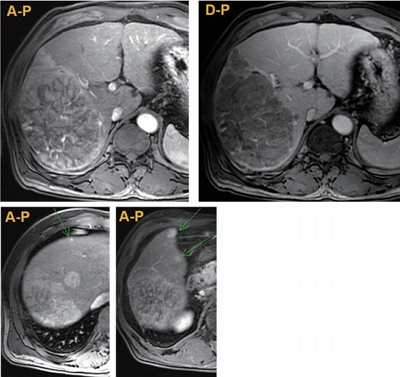
- Proton beam therapy (PBT) is one of the advances in radiotherapy techniques, which enables dose escalation with lower probability of radiation-induced liver or gastrointestinal injuries. However, the chest wall proximal to the tumor can be affected by high dose irradiation. Here, we report on a 58-year-old male patient who presented with huge hepatocellular carcinoma, received treatment with transarterial chemoembolization and PBT, and developed severe chest wall pain due to radiation-induced myositis. The patient’s symptoms were controlled by oral steroids.
-
Citations
Citations to this article as recorded by- Pectoralis Major Radiation Myonecrosis After Lung Stereotactic Body Radiation Therapy
Jason Gurewitz, Anand Mahadevan, Benjamin T. Cooper
Practical Radiation Oncology.2024; 14(3): 189. CrossRef - Current role of proton beam therapy in patients with hepatocellular carcinoma
Gyu Sang Yoo, Jeong Il Yu, Hee Chul Park
International Journal of Gastrointestinal Intervention.2021; 10(4): 175. CrossRef
- Pectoralis Major Radiation Myonecrosis After Lung Stereotactic Body Radiation Therapy
 First
 Prev




 Follow JLC on Twitter

